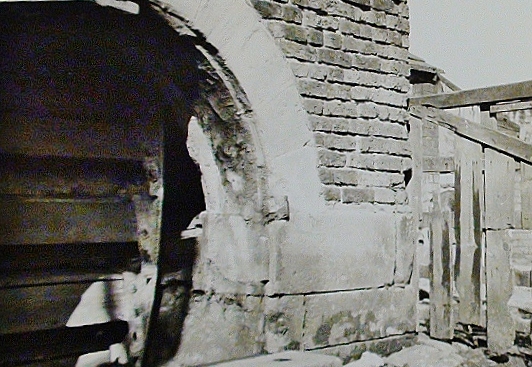
There was a water powered corn mill on the River Aire at the end of Fleet Lane in Oulton in medieval times. Two more mills, for whiting and flint, were added later, hence the name Fleet Mills.
One of the earliest written references comes from 1341 during the reign of King Edward III. Two water mills and a house at Fleet were recorded in a survey of Yorkshire parishes by John Gynwell, a royal government official, and William Blaby, the auditor of accounts and surveyor for Henry of Grosmont, Earl of Derby and later Duke of Lancaster. The survey was made to assess land values and the status of local landowners and tenants across the vast northern estates of the House of Lancaster. It was part of a national assessment ordered by the king to raise taxes to pay for the Hundred Years War.
A jury of twelve men of Rothwell parish, including Henry of Oulton, were questioned under oath to determine the exact financial yields of the land. Most of the local male residents were named. They included free tenants who had civil rights and the freedom to leave the parish; small farmers called neifs who couldn’t leave without permission; and labourers, or cottagers who had small plots of land and were obligated to work the lord of the manor’s estate.
As well as the water mills at Fleet the survey recorded two water mills at Hunslet and a mill close to the manor house in the centre of Rothwell near the church. A mill for fulling, or beating newly woven woollen cloth, was noted on the beck at Oulton. Between the Hunslet and Fleet mills was a two mile long fishery on the River Aire.
In the 1940s, the Oulton vicar Geoffrey Hamish Mercer, read and paraphrased many old manuscripts for his handwritten Notes for a History of Oulton. The earliest reference he found came from 1425. It stated: “John Shercrofte holds the mills of Flete and the mill before the gate of the manor.”
Sixty years later, in 1485, according to an article on local history in the Leeds Mercury in July 1885, a letting was made to Thomas Elys (Ellis) for seven years of “all the water mills called Fletemylles within the Honour of Pontefract, with all the fisheries and water rights” at 20 marks and an improved rent of 15 shillings and four pence (15/4)”. In 1574 the mill was associated with a Richard Burton.
Some of the documents Mercer read also referred to a Milne Road, presumably an earlier name for Fleet Lane as milne was the Old English word for mill.
According to John Batty, in his History of Rothwell published in 1877, the name fleet is derived from the Anglo-Saxon word fletan. It meant swift running when referring to the rapidity of a stream or river. The original mill was located on the eastern edge of the old parish of Rothwell which historically was just under six miles wide.
It’s unknown if there was a mill on the site before the Norman invasion in 1066 as the only known reference to a mill locally comes in the Domesday Book survey from 1086. It was done to identify areas of land to be taxed and mentions a mill in Rothwell manor, probably the one on the beck near Holy Trinity church that survived into the twentieth century.
There’s evidence that Fleet Mills were extensively rebuilt during the latter part of the 18th century and further improvements were made in the 19th century. From about 1786 they came under the control of the Aire & Calder Navigation. A serious fire in 1924 destroyed much of the interior of the buildings and they were finally demolished in 1967.
Click on the pages in this section to read more about the mills’ history and the tenants and workers who operated them.